
🥚✨ Curiosity Club Fizz-Paint Easter Eggs
At Curiosity Club, we believe science should be a little messy… a little colorful… and a LOT magical.
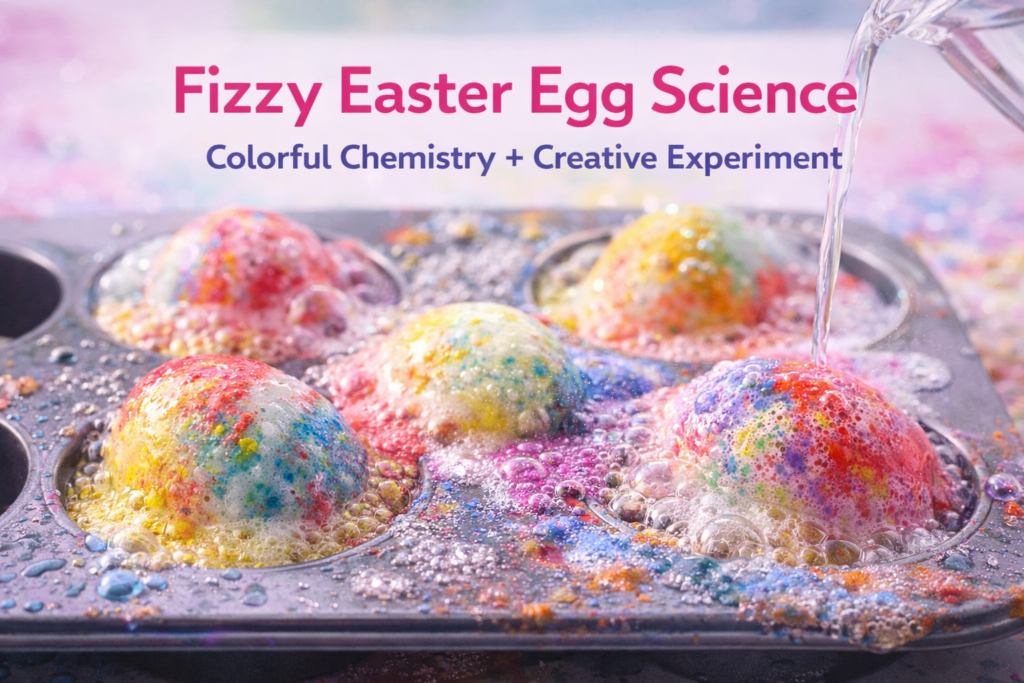
Today’s experiment turns ordinary eggs into fizzing science art. When vinegar touches baking soda, a bubbly chemical reaction happens — and suddenly your egg becomes a tiny science canvas!
Bug calls this “egg-sploding art.”
Babe calls it “a classic acid-base reaction.”
Both are correct.
🧪 You’ll Need
• Eggs (hard-boiled or blown out eggs work best)
• Baking soda
• Water
• Vinegar
• Food coloring
• Muffin tin
🎨 What To Do
1️⃣ Mix the fizz paint
In a muffin tin, mix 1 tablespoon baking soda + 1 tablespoon water.
2️⃣ Add color
Add a few drops of food coloring and stir until it becomes a thick, colorful paint.
3️⃣ Paint your eggs
Use a spoon, brush, or cotton swab to paint designs all over your eggs.
4️⃣ Add the science
Slowly pour a little vinegar over the painted designs.
Get ready…
Fizz! Bubble! Pop!
Your egg art will come to life.
5️⃣ Let them dry
Set the eggs aside and allow them to dry completely so you can see all the colorful patterns.
🧠 Babe’s Fun Fact
When vinegar (an acid) touches baking soda (a base), they react and create carbon dioxide gas — those fizzy bubbles you see popping on your egg!
🤪 Bug’s Silly Science Moment
Bug:
“Are we decorating eggs or making tiny volcanoes?!”
Babe:
“Technically… both.”
✨ Try experimenting with:
• rainbow colors
• swirl patterns
• dripping designs
Every egg becomes a one-of-a-kind science masterpiece.