
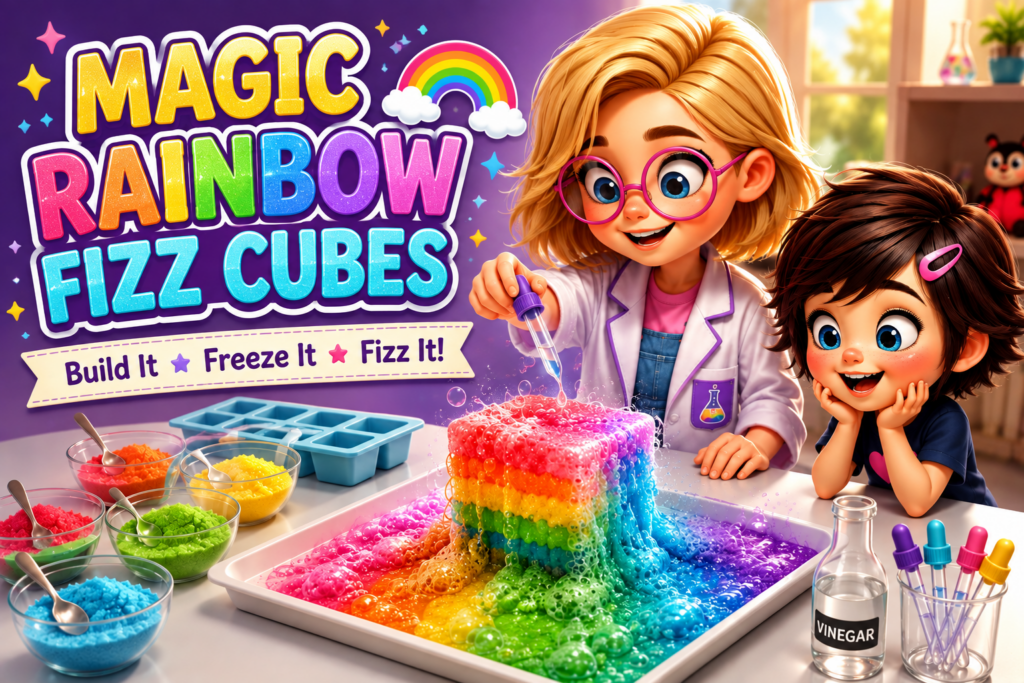
🌈 What if you could build a rainbow…and then make it disappear with SCIENCE?
First, we’re going to squish, scoop, stack, and freeze our own colorful rainbow cubes.
Then comes the really fun part.
Grab the vinegar because these little rainbows aren’t sticking around forever. One splash and…
FIZZZZZZZ! 🫧🌈
The colors bubble, foam, blend, and slowly melt away right before your eyes.
Babe has officially classified this as chemistry.
Bug has officially classified it as RAINBOW DESTRUCTION. 😂
Welcome to Magic Rainbow Fizz Cubes!
🎒 What You’ll Need
Gather up:
- 1 cup baking soda
- About ¼ cup water
- Washable liquid watercolor in 5 colors
- Silicone cube mold or ice cube tray
- ½ cup white vinegar
- Mixing bowl
- 5 small bowls or cups
- Spoon
- Tray or shallow bin for fizzing
Curiosity Club Tip: A squeeze bottle, dropper, or small cup makes adding the vinegar even more fun.
🧪 Let’s Make Some Rainbow Magic
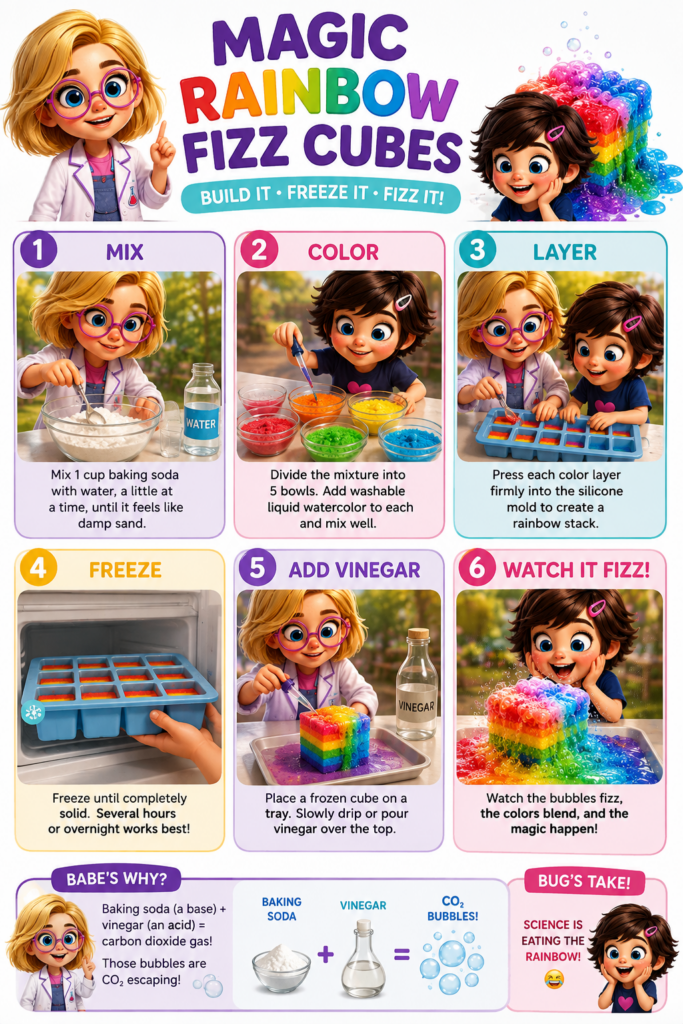
Step 1: Make your squishy science sand. Pour 1 cup baking soda into a bowl. Add the water a little at a time, mixing as you go.
You’re looking for a texture that feels a bit like damp sand.
Try squeezing some in your hand.
Does it hold together?
Perfect!
🐞 Bug: “SNOWBALL!”
🧠 Babe: “Please don’t throw the experiment.”
Step 2: Make your colors. Divide the baking soda mixture between five small bowls. Add a little washable liquid watercolor to each one and mix.
Suddenly your plain white baking soda has turned into a rainbow!
Try red, orange, yellow, green and blue—or invent your own color combination.
Step 3: Build the rainbow. Now for the strangely satisfying part.
Press a little of each color into your silicone mold, one layer at a time.
Press each layer firmly before adding the next so you get those gorgeous rainbow stripes.
Red…
Orange…
Yellow…
Green…
Blue!
🌈 Babe: “We’re creating layers.”
🐞 Bug: “We’re making tiny rainbow LASAGNA.”
Fair enough.
Step 4: Freeze! ❄️ Pop your mold into the freezer until the cubes are completely solid. Overnight is easiest, but several hours should do the trick.
And now comes the hardest part…
Waiting.
👀 The Wait & Wonder Challenge
Before you fizz anything, ask your little scientist:
What do YOU think will happen when we pour vinegar onto our frozen rainbow cube?
Will it:
🫧 Bubble?
🌈 Change colors?
💦 Melt?
💥 Explode?
🤔 Do absolutely nothing?
Make a prediction before you test it!
💥 Step 5: LET THE FIZZING BEGIN!
Remove your frozen rainbow cubes and place them on a tray or in a shallow bin.
Now slowly pour, squeeze, or drip white vinegar onto one.
And watch.
FIZZZZZZZZZ!
Tiny bubbles appear.
Foam creeps over the rainbow.
Colors begin running together.
One layer starts revealing another.
Add another squirt.
FIZZZZZ!
🐞 Bug: “MY RAINBOW IS MELTING!”
🧠 Babe: “Technically, there’s a chemical reaction occurring.”
🐞 Bug: “SCIENCE IS EATING MY RAINBOW!”
Close enough.
🧠 Babe’s Why Guide: Why Does It Fizz?
Here’s the really cool part.
Baking soda is a base. Vinegar is an acid.
When the two meet, they react and produce a gas called carbon dioxide.
Those hundreds of tiny bubbles you see?
That’s carbon dioxide gas escaping!
The frozen cube makes the experiment especially interesting because the vinegar has to work its way through the colorful layers as the cube thaws and reacts.
🔎 Try This Next: Become a Fizz Scientist
Don’t stop after one cube!
Turn it into a mini investigation.
Try adding vinegar with a dropper to one cube and pouring it onto another.
Which reacts faster?
Try a frozen cube and a little leftover unfrozen mixture.
Do they react differently?
Add vinegar to just one corner of a rainbow cube.
What happens to the colors?
There isn’t just something to see here—there’s something to discover.
🎯 What Little Scientists Are Actually Learning
- Chemistry: acids, bases and chemical reactions
- Gas formation: spotting carbon dioxide bubbles
- Cause and effect: “I added this…and THAT happened!”
- Prediction: thinking about an outcome before testing
- Color science: watching colors mix during the reaction
- Fine-motor skills: scooping, pressing, squeezing and using droppers
- Sensory exploration: squishing the damp mixture and watching bubbly foam
- Patience: waiting for those rainbow cubes to freeze!
💜 Grown-Up Note
Activities like this don’t need a complicated explanation to become meaningful science.
Ask:
“What do you notice?”
Then give them time to tell you.
Maybe they’ll notice the bubbles.
Maybe they’ll discover that one color disappears before another.
Maybe they’ll wonder why more vinegar makes more fizz.
Those tiny observations are where scientific thinking begins.
And if their main conclusion is…
“WE NEED TO MAKE MORE RAINBOWS!”
We’d call that successful research. 🌈🧪