
☀️ Can You Cook With Sunshine?
The Sun is more than a giant glowing ball in the sky.
Its energy can warm the sidewalk, heat up your car, help plants grow… and—with a little engineering—it can even warm up a snack!
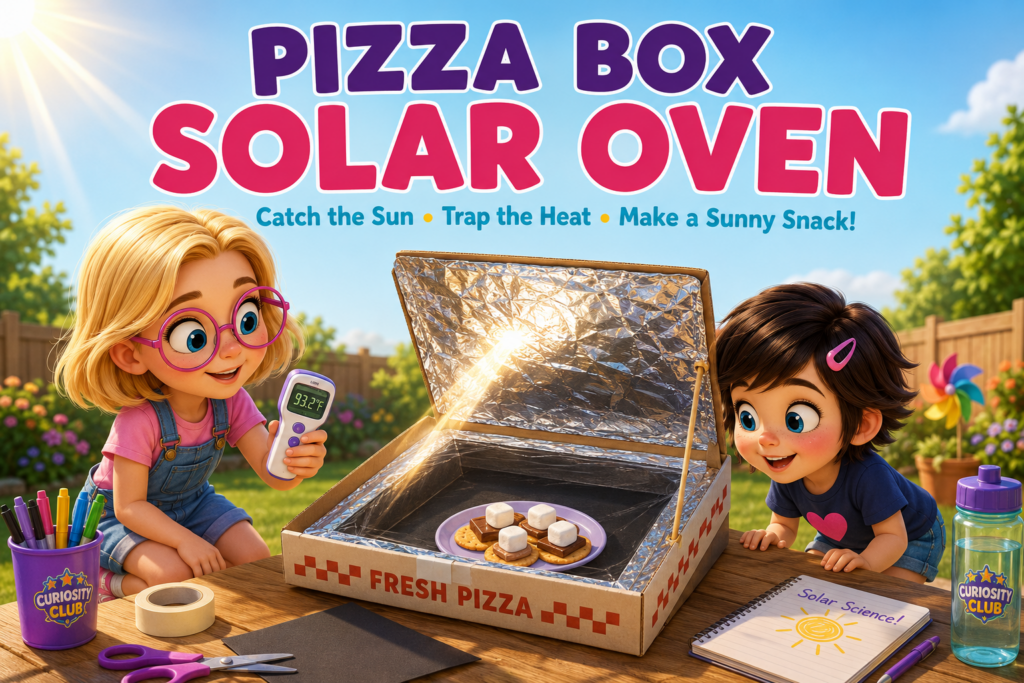
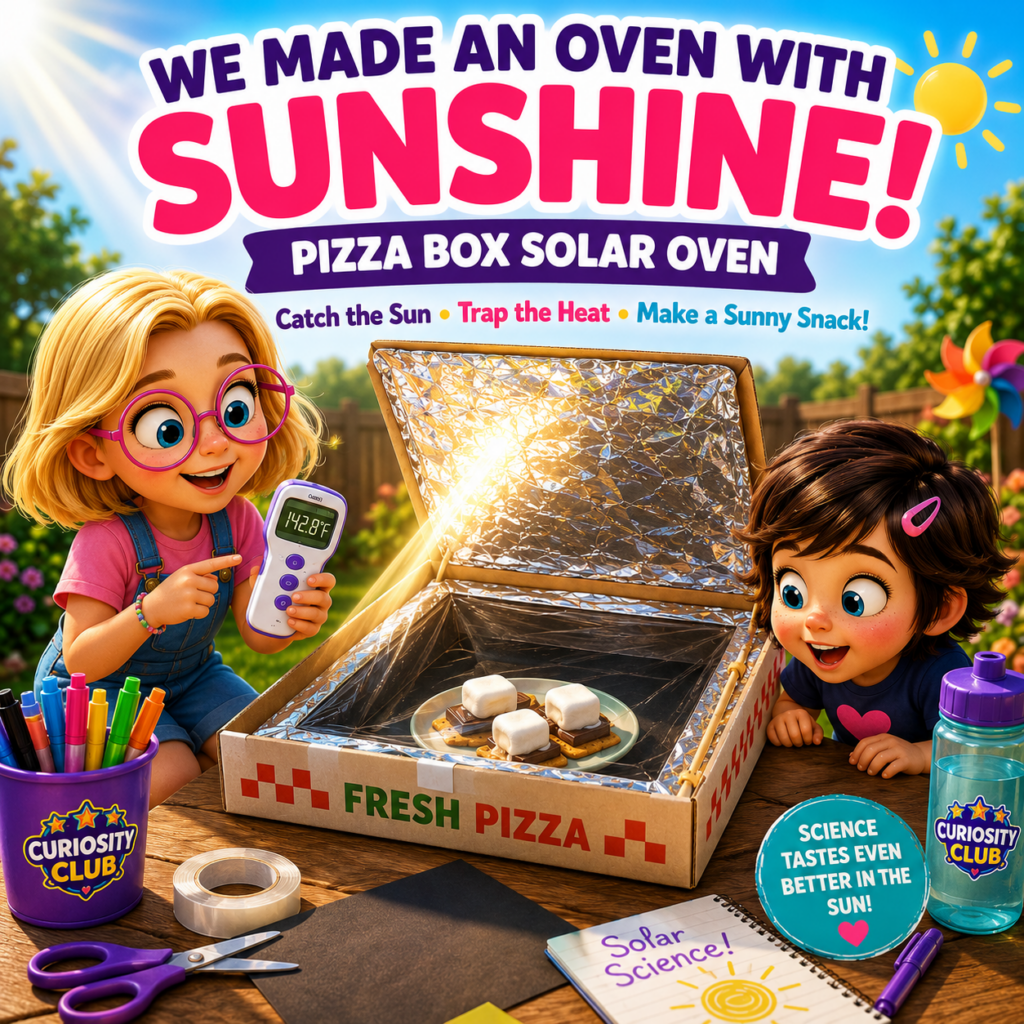
Today, Babe and Bug are turning an ordinary pizza box into a mini solar oven.
No plug.
No batteries.
Just sunshine, a cardboard box, and some clever science.
Bug: “So… we’re eating sunlight?”
Babe: “Technically, we’re using solar energy to produce thermal energy.”
Bug: “Sun snacks. Got it.”
📦 What You’ll Need
Gather:
- 1 clean pizza box
- Aluminum foil
- Clear plastic wrap
- Black construction paper
- Tape
- Scissors or a craft knife for grown-up use
- Wooden skewer, ruler, or stick to prop up the reflector
- Plate, napkin, or small piece of parchment paper for food
- A sunny outdoor spot
- Oven mitts or tongs for handling warm items
- Optional: thermometer
For testing your oven: Try something simple that only needs warming or melting, such as crackers topped with chocolate and marshmallows.
🔨 Build Your Sunshine Oven

Step 1 — MAKE THE WINDOW
Keep the pizza box closed.
Have a grown-up cut three sides of a large rectangle in the top of the lid, leaving one side attached like a hinge.
Fold this flap upward.
Congratulations—you’ve just built your solar reflector!
Step 2 — MAKE IT SHINY
Cover the inside of the flap with aluminum foil.
Smooth it as much as you can and tape it securely.
The shiny foil helps reflect more sunlight toward your oven.
Babe adjusts her glasses.
“Angle matters!”
Bug immediately starts moving the flap around.
“COME TO ME, SUNBEAMS!”
Step 3 — ADD A CLEAR WINDOW
Cover the opening you cut with clear plastic wrap.
Tape around the edges so the opening is covered securely.
For an even better heat-trapping window, add a layer of plastic wrap to both sides of the opening, leaving a little air space between them.
Now sunlight can enter while some of the warmed air stays inside.
Step 4 — MAKE A DARK FLOOR
Line the bottom of the pizza box with black construction paper.
Why black?
Dark surfaces absorb more incoming light than shiny reflective surfaces and convert more of that energy into heat.
So our oven has two different jobs:
Shiny foil = REFLECT
Black paper = ABSORB
Step 5 — ADD YOUR TEST SNACK
Place your food on a small plate, parchment paper, or another food-safe surface inside the box.
Close the pizza box.
Never put food directly onto craft materials.
Step 6 — AIM FOR THE SUN
Take your oven outside to a bright, sunny spot.
Use a ruler, skewer, or stick to hold the foil-covered flap at an angle that reflects sunlight through the window and into the box.
Look for the brightest patch of reflected light.
That’s your clue!
⏰ WAIT & WONDER
Now comes the hardest part…
WAITING.
Check your solar oven every 10–15 minutes without opening it unnecessarily.
Ask your little scientist:
☀️ What do you predict will happen?
🌡️ Will the box get warmer than the air outside?
⬛ Why do you think we used black paper?
✨ What happens if we change the reflector’s angle?
☁️ What happens when a cloud covers the Sun?
If you have a thermometer, turn it into an experiment.
Record the temperature when you begin and again every 10 minutesResults will vary considerably with sunlight, outdoor temperature, wind, box construction and reflector angle. Think of this as a solar-energy experiment that can warm or melt foods, rather than a dependable replacement for a kitchen oven.
Download the Solar Oven Temperature Test worksheet here

🧠 BABE’S WHY?
How does a solar oven work?
Sunlight carries energy.
The foil-covered flap reflects sunlight into the box.
The black paper absorbs much of that light energy and turns it into thermal energy, warming the inside of the box.
The clear plastic lets sunlight enter while helping reduce heat loss from warm air moving away.
And the cardboard box provides some insulation, slowing heat transfer to the surrounding air.
Together, you’ve created a tiny system for collecting and holding onto solar energy.
🐞 BUG’S VERSION
“So the foil says, ‘SUNLIGHT—THIS WAY!’”
“The black paper says, ‘MINE!’”
“And the plastic wrap says…”
Bug dramatically guards the pizza box.
“NOBODY LET THE WARMTH ESCAPE!”
Babe pauses.
“Surprisingly accurate.”
🔬 What Kids Are Actually Learning
This simple box packs in a surprising amount of STEM:
- ☀️ Solar energy — energy from sunlight
- ✨ Reflection — light bouncing from the shiny foil
- ⬛ Absorption — dark material taking in light energy
- 🌡️ Heat transfer — observing how energy warms materials
- 📦 Insulation — slowing the movement of heat
- 🛠️ Engineering — designing and improving a device
- 🔮 Prediction — deciding what they think will happen
- 📊 Measurement — recording temperature changes
- 🔁 Iteration — changing the design and testing again
🧪 Turn It Into a Real Experiment
Don’t stop after the first snack.
Ask:
What could make our solar oven work better?
Try changing one thing at a time:
- Reflector angle
- One versus two layers of clear plastic
- Black paper versus white paper
- Sunny versus partly cloudy conditions
- Different box insulation
- Different times of day
Then compare your results.
That’s engineering!
💜 Grown-Up Note
The snack is fun, but it isn’t really the important part.
The magic happens when your child starts asking:
“What if we changed this?”
That’s the beginning of engineering.
Their first solar oven doesn’t need to work perfectly. A flap that needs adjusting or a marshmallow that refuses to melt creates another question to investigate.
Build it. Test it. Change it. Try again.
That’s what scientists and engineers do.
-
Fluffy Pumpkin Slime
Fluffy Pumpkin Slime Squish It • Stretch It • Explore the Science! What if you could scoop up a soft, stretchy pumpkin cloud—and squish it between your fingers? This fluffy pumpkin slime is part science experiment, part sensory play, and completely irresistible. A swirl of orange color and a tiny sprinkle of pumpkin-pie spice transform…
-
Halloween Chalk Rockets
Halloween Chalk Rockets: Fizz, Pop, Blast Off! What happens when a tiny Halloween character drinks a bubbling potion? It might just blast into the sky! Halloween Chalk Rockets combine fizzy science, colorful outdoor art, and just the right amount of spooky silliness. Decorate each little rocket as a ghost, pumpkin, monster, or vampire—then add the…
-
Fall Rainbow Lava Lamp Bottle
Fall Rainbow Lava Lamp Bottle 🎨🍂 Pour It • Fizz It • Watch Fall Colors Dance! What if you could catch the swirling colors of autumn inside a bottle? With a little oil, colorful water, and one fizzy tablet, you can create a bubbling fall science show that looks like tiny leaves floating up and…